
Free VPN vs. paid VPN: The privacy risk you don’t see
The truth about what you’re really paying for, especially when you’re not paying

Share
Free VPNs promise privacy for nothing — but as the saying goes, if you’re not paying for the product, you are the product. The truth is that many free VPNs track browsing data, inject ads, or quietly sell your information to keep their lights on.
Paid VPNs claim to be the safer choice, but this is not really that true. Some VPNs log metadata, while others operate centralized infrastructures vulnerable to tracking and censorship.
That’s where decentralized privacy networks like NymVPN completely change the game when it comes to privacy protections. NymVPN offers transparent, decentralized, open-source protection and a 7-day free trial that doesn’t compromise your data.
In this guide, the Nym team breaks down how free and paid VPNs really work, the trade-offs you face with each, and how Nym’s decentralized model protects your privacy at the deepest level — even from us.
What exactly is a “Free VPN”?
A free VPN gives you access to encrypted servers without charging a subscription. In theory, that means you can hide your IP address and browse securely at no cost. In practice, it’s rarely that simple.
Operating a VPN requires real infrastructure: global servers, engineers, maintenance, and bandwidth. Free VPNs have to earn money somewhere — and when you don’t pay, your data becomes the revenue stream. And these days, personal data is a goldmine.
Common monetization tactics include:
- Tracking and selling data to advertisers or data brokers
- Injecting ads directly into your browsing experience
- Pushing in-app upgrades or limiting free bandwidth until you pay
If you’ve ever wondered how a “no-cost” VPN can afford servers across continents, the answer usually involves data resale or ad networks — both of which undermine the privacy a VPN is supposed to provide.
For a closer look at how trackers operate across the web, see our breakdown on Who is tracking you online, and why?.
How “Free” VPNs really make money
1. Tracking and selling your metadata
Your browsing patterns, device info, and connection times are all valuable. Free VPNs log this metadata and sell it to advertising or analytics firms. Even if the content of your browsing is encrypted, your behavior — when you log in, how long you stay connected, which sites you visit — is gold for marketers.
Learn more about how this metadata can expose you and what you do online.
2. Ad injection
Many free VPNs display pop-ups or sponsored banners in the app interface. Some go further, injecting ads into the pages you visit. These ads can contain trackers or malware, undermining the privacy of your browsing history you thought was being protected. In this case, it is the VPN itself that is spying on you.
3. Bandwidth limits and paywalls
Some “free” plans offer just 500 MB to 1 GB per month — barely enough for an hour of streaming. Others throttle speed so severely that the service is unusable until you upgrade. It’s basically a bait-and-switch model disguised as generosity.
Are free VPNs ever safe?
Rarely. Even legitimate-looking free providers often log user data under vague “diagnostics” or “performance” language. Others skip encryption altogether, acting as unprotected proxies. Free VPNs can also expose you to:
- Malware hidden in ad libraries
- Spyware that tracks your ever move
- Leaky DNS requests that reveal your browsing to ISPs
- Fake apps or botnets impersonating real VPNs on app stores
If privacy is your goal, using a free VPN can actually be worse than using no VPN at all.
What you get with a paid VPN
Paid VPNs charge users directly, which gives them an incentive to deliver quality — not to monetize your data behind the scenes. Subscriptions can fund better infrastructure, faster servers, and stronger encryption.
Any reputable paid VPN designed for privacy like NymVPN is should offer:
- High-speed servers
- No bandwidth throttling
- No ads
- Advanced encryption
- No logs policies or ideally a can’t log infrastructure
- Defenses against VPN blocking
- Multi-device compatibility
- Publicly available audits
- Open source code base
- Payments in crypto
Still, “paid” doesn’t automatically mean “private.” Many corporate VPNs remain centralized, meaning all traffic flows through a few company-owned servers. Those servers create single points of failure — and potential surveillance.
To understand why decentralization matters for privacy online, read Nym’s explainer on What is decentralization?.
Why NymVPN redefines “paid” VPN privacy
NymVPN isn’t just another subscription-based VPN. It’s built on a decentralized mixnet, a privacy layer designed to hide not just what you send but that you’re sending anything at all.
A network with no central authority
Instead of relying on corporate data centers, NymVPN routes traffic through independent community-run nodes. No single operator can see both your origin and destination. And Nym has no idea that you’re ever using the network.
True metadata protection
Traditional VPNs encrypt your data but still expose a lot of metadata like your IP address, when you send data, to whom, from where, and how much — enough to fingerprint your activity. Nym’s mixnet shuffles and delays packets in mathematically random patterns, breaking these correlations entirely. With NymVPN, you remain unlinkable to what you do online.
This makes it resilient even to large-scale surveillance systems like those described in The surveilled internet.
Zero-knowledge sign up
Nym replaces account logins with anonymous credentials, so even we don’t know who’s connecting. You can authenticate, subscribe, and use the network without revealing an email or identity.
Pay anonymously in crypto
How you pay for a privacy service like a virtual private network (VPN) makes a big difference. Paying with normal credit or debit cards can reveal your name and personal information to the VPN company, which can then link it to your traffic over the VPN.
This is why cryptocurrency can be a great way of paying privately so you remain unlinkable to your online activities. NymVPN accepts the widest range of cryptocurrencies of any VPN provider, notably privacy coins like Monero and Zcash (ZEC).
Open source by default
Every component — from client software to mixnet code — is public and auditable. Anyone can inspect it. No blind trust required.
Censorship resistance = no VPN blocking
Your VPN isn’t really protecting your privacy if it’s blocked in a censored region. And free VPNs are often funded by governments to gain backdoors on the traffic of users.
NymVPN incorporates advanced features to combat censorship and VPN blocking:
- AmneziaWG (a fork of the WireGuard protocol)
- What is QUIC
- Stealth API Mode

How to get free VPN trial for NymVPN
Step 1: Sign up for your free trial
Step 2: Install the app
Download NymVPN for desktop or mobile on iOS, macOS, Android, Windows, and Linux.
Step 3: Add your anonymous credential
After activating your free trial, you’ll receive an anonymous credential (24-word phrase). Simply save it securely and copy and paste it into your NymVPN app to activate your account on your device.
Step 4: Connect and browse
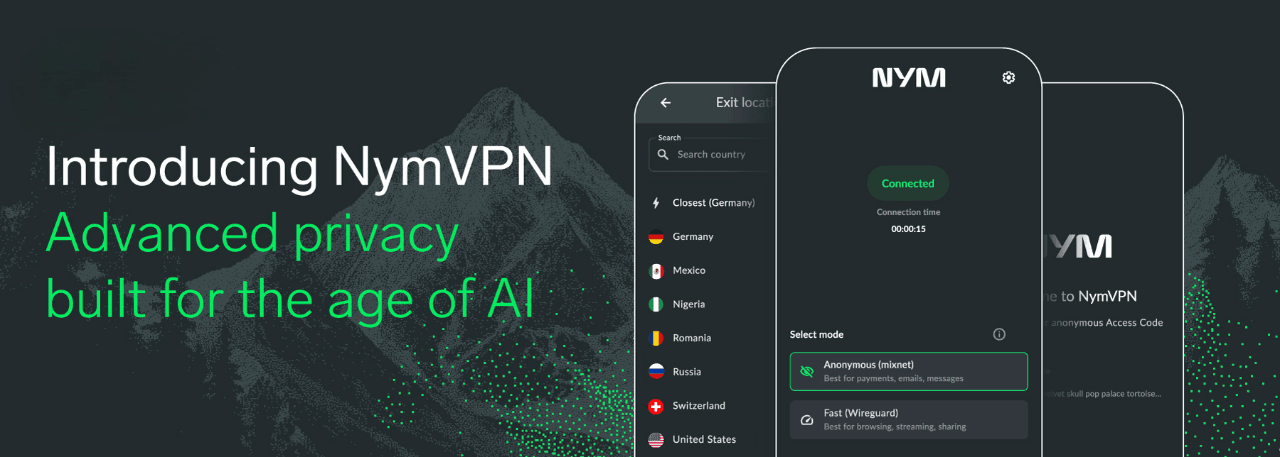
Choose between the Fast mode for decentralized privacy while browsing or streaming, or the Anonymous mode for sensitive communications, email, or financial and crypto transactions. Each packet takes a different path, encrypted and disguised to prevent tracking.
For an extra layer of anonymity, consider pairing NymVPN with privacy browsers and private search engines.
Building your privacy tech stack
NymVPN is the foundation, but full digital privacy often involves layering tools. Here’s how to round out your stack:
- Use secure messaging apps that don’t log metadata such as Signal and Session.
- Harden your passwords with managers and 2FA to prevent reuse, and be aware of password risks.
- Check for data leaks using privacy-safe dark web monitoring.
- Use privacy coins like Monero or Zcash for anonymous transactions
- Stay aware of network risks like DNS leaks, packet sniffing, or public Wi-Fi tracking.
Why the “Free vs. Paid” debate misses the point
It’s not really about price: it’s about trust and architecture.
- Free VPNs make you the product
- Paid VPNs ask for your trust with little guarantee
- NymVPN removes both from the equation
By decentralizing the network itself, Nym eliminates the need for trust entirely. There’s no single company collecting your traffic, and no logs to subpoena or hack. Privacy shouldn’t depend on who runs your VPN — it should depend on cryptography, open code, and mathematics.
Free VPN vs. paid VPN: FAQs
Almost all are not recommended and come with serious risks and privacy trade-offs. Some limit bandwidth, others log data. True “free” privacy tools are rare because server costs are real.
Yes, after the one-week free trial you can subscribe monthly or annually. Plans fund the decentralized infrastructure — never through ads or tracking.
Absolutely. The network supports high bandwidth and anonymous payments. For crypto trading privacy, check Best VPN for crypto trading.
Nym hides metadata itself, not just content. That means your traffic patterns, connection times, and routes are invisible even to us.
Yes. The entire codebase is public, auditable, and community-maintained — a key difference from proprietary VPNs that rely on trust instead of proof.
About the authors
Casey Ford, PhD
Communications LeadTable of contents
Keep Reading...
Decentralized VPNs (dVPNs): What are they?
What decentralized VPNs are and how they are different from traditional ones.

Nym’s zero-knowledge network: No logging promises needed
Turning a VPN no log’s policy into a network design and guarantee
Why NymVPN's Anonymous mode provides the best privacy
Appreciating the value of technologically enhanced VPN privacy